AWS Certified DevOps Engineer – Professional (DOP-C02): Exam Guide for 2026
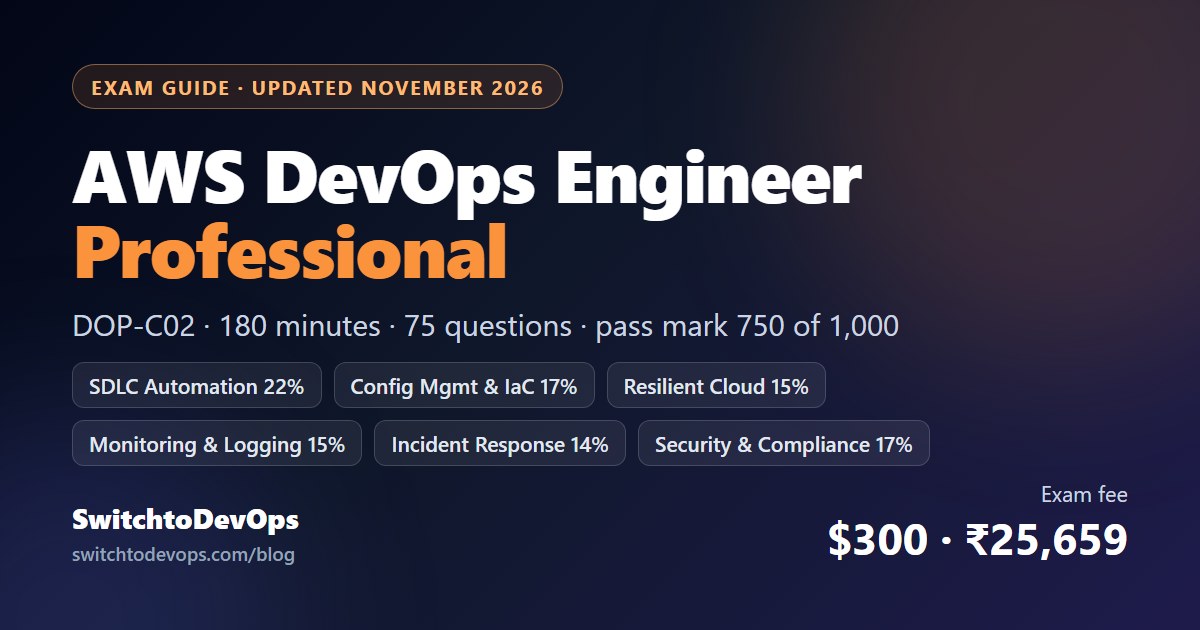
The short answer: the AWS Certified DevOps Engineer – Professional exam is currently DOP-C02. It costs 300 US dollars (AWS lists ₹25,659 for vouchers bought in rupees), lasts 180 minutes and has 75 questions, of which 65 are scored. You need 750 on a scale of 100 to 1,000 to pass, and the certification is valid for three years. There is no prerequisite certification, but AWS recommends two or more years of experience running AWS environments, and that recommendation is worth taking seriously.
Most people who search for this exam are asking two questions at once: what is on it, and should I take it now. This guide answers both. It is written for engineers in India, so the costs are in rupees as well as dollars, and the preparation plan assumes you have a job.
The exam at a glance
| Item | Detail |
|---|---|
| Exam code | DOP-C02 |
| Fee | 300 US dollars; AWS lists ₹25,659 for vouchers bought in rupees through Pearson |
| Length | 180 minutes; candidates whose first language is not English can request 30 extra minutes |
| Questions | 75: 65 scored and 10 unscored, multiple choice and multiple response |
| Pass mark | 750 on a scaled score of 100 to 1,000; you need to pass overall, not each section |
| Where | A Pearson VUE test centre or online with a remote proctor |
| Languages | English, Japanese, Korean and Simplified Chinese; there is no Hindi version |
| Prerequisites | None required; AWS recommends 2+ years running AWS environments, plus experience with the software development lifecycle and scripting |
| Valid for | 3 years |
| If you fail | Wait 14 days, then pay the full fee again; there is no limit on attempts |
Checked against AWS's exam page and exam guide in November 2026. AWS has not announced a successor to DOP-C02; if you are reading this much later, check the exam code before you study.
Who should take it now, and who should wait
The Professional exam is written for people who already do this work. Its questions are long scenarios: a team with a specific deployment problem, four plausible answers, and one that fits the constraints in the question better than the rest. You can memorise what CodeDeploy does. What the exam tests is whether you would choose a blue/green deployment or a canary for that team, and why the other options fail on cost, speed or risk.
That is why the experience recommendation matters. People with a couple of years of real AWS work recognise the scenarios because they have lived them. People without it try to reason their way through every option from first principles, and 180 minutes stops being enough.
Take it now if you have been running workloads on AWS for a year or two, you own or contribute to pipelines and infrastructure code at work, and you want a credential that matches what you already do. For someone in that position it is often the certification that helps most at senior interviews.
Wait if you are switching into DevOps, are a fresher, or have used AWS mainly through a course. Take the AWS Solutions Architect – Associate exam first; it is cheaper, it fits what a course actually teaches, and passing it earns you a 50 percent discount voucher for your next AWS exam. Come back to DOP-C02 after you have real work to draw on.
One question we get a lot: does the Professional exam require the Associate first? No. AWS removed formal prerequisites years ago. The Associate is a recommendation for your own sake, not a rule.
The six domains, and what they actually test
AWS splits the exam into six domains. The percentages are the share of scored questions; they tell you where to spend your study time.
| Domain | Weight | What the questions are really about |
|---|---|---|
| 1. SDLC Automation | 22% | Pipelines: build, test and deployment stages, artefacts, approvals, and choosing a deployment strategy (in-place, rolling, blue/green, canary) for a given situation |
| 2. Configuration Management and IaC | 17% | CloudFormation and the CDK at scale, managing many accounts and Regions, keeping configuration consistent and detecting drift |
| 3. Resilient Cloud Solutions | 15% | High availability across Availability Zones and Regions, scaling, backups and disaster recovery that meet a stated recovery objective |
| 4. Monitoring and Logging | 15% | Collecting and analysing metrics and logs, and automating a response when something crosses a threshold |
| 5. Incident and Event Response | 14% | Event-driven automation, troubleshooting failed deployments and recovering from incidents |
| 6. Security and Compliance | 17% | Identity and access at scale, secrets, encryption, and auditing changes across accounts |
Two things stand out. First, more than a fifth of the exam is pipelines and deployment strategies, so that is the domain to master first. Second, the exam leans heavily on AWS's own tools: CodePipeline, CodeBuild, CodeDeploy, CloudFormation, Systems Manager, CloudWatch, EventBridge and Organizations come up again and again. If your day job runs on Jenkins and Terraform, your concepts are right but your vocabulary is not, and that gap is where most of your preparation time will go.
Is it worth it for a DevOps engineer in India?
It depends on where you are in your career, and on what you expect it to do.
For an engineer with two or more years of AWS work, it is a strong signal at product companies and global capability centres, where AWS-heavy platform teams want evidence that you can design and operate at scale, not just deploy a sample app. It also forces you to learn the AWS-native toolchain properly, which helps if your experience so far has been with third-party tools.
For a fresher or career switcher, it is the wrong first purchase. Interviewers for junior roles care far more about projects you can explain, and a Professional certification with nothing behind it invites questions you will struggle to answer. The Associate exam and a portfolio do more for you at that stage.
On cost: 300 dollars, or about ₹25,659, plus whatever you spend on practice material, plus a little AWS usage for hands-on practice. If you already hold an AWS certification, the 50 percent discount voucher halves the exam fee. Pay figures for the roles this exam targets are in our DevOps engineer salary guide; the honest summary is that the certification helps you reach the top of a band, not jump to a new one.
A realistic 8-week preparation plan
This assumes you work full time, have one to two years of AWS experience, and can find about eight to ten hours a week. If you have less experience, stretch it to twelve weeks rather than cramming.
| Weeks | Focus | Hands-on task |
|---|---|---|
| 1 | Read AWS's official exam guide end to end and take a practice test cold | Note every question you guessed, not just the ones you got wrong. That list is your real syllabus. |
| 2–3 | SDLC automation: CodePipeline, CodeBuild, CodeDeploy, deployment strategies | Build one pipeline that deploys the same app with blue/green and then canary, and roll each back on purpose |
| 4 | Configuration management and IaC: CloudFormation, StackSets, the CDK, Systems Manager | Deploy one stack to two Regions with StackSets and change a parameter safely |
| 5 | Monitoring, logging and incident response: CloudWatch, EventBridge, automated remediation | Create an alarm that triggers an automatic fix, then break the thing it watches |
| 6 | Resilience and security: multi-AZ and multi-Region patterns, IAM at scale, secrets, auditing | Write down the recovery time and recovery point for a design, then check that it actually meets them |
| 7 | Full timed practice exams | Review every answer, including the right ones, and write one line on why each wrong option is wrong |
| 8 | Weak domains only, then book | Book for the end of the week while it is fresh; a date on the calendar does more than another month of reading |
A note on practice material: use AWS's own exam guide and sample questions as the reference for what is in scope. Third-party question banks are useful for timing practice, but some still carry questions written for the previous version of the exam, DOP-C01, which AWS retired in 2023. If a question mentions a service you cannot find in the current AWS console, skip it.
On the day
The arithmetic first: 180 minutes for 75 questions is about two minutes and twenty seconds per question, and the scenarios are long. Read the last line of each question first, so you know what you are choosing for, then the scenario. Answer what you can, flag what you cannot, and come back. Leaving a question blank scores the same as getting it wrong, so never leave one empty.
If English is not your first language, request the 30 extra minutes through your AWS Certification account before you schedule; it applies to every exam you take afterwards. For an online proctored exam, run Pearson VUE's system test on the same computer and network you will use on the day, and clear your desk completely. Most stories about an exam being cancelled midway turn out to be about the room, not the questions.
After you pass: keeping it current
The certification is valid for three years. To renew it, you can pass the current version of the exam again, which resets the clock for another three years. Since June 2026 AWS has also been running an open beta of a second route through a paid AWS Skill Builder subscription: once you are within 90 days of expiry, completing enough of the relevant learning (700 points for a Professional certification) extends it by one year. As a beta, its terms may change, so check AWS's recertification page when your time comes.
Passing also gives you a 50 percent discount voucher, usable for recertification or for any other AWS exam. If you are planning a second certification, such as Solutions Architect – Professional, use it.
Where our course fits
Our live DevOps course is not an exam-cramming course for DOP-C02, and we would not recommend it as the fastest route to this particular exam. What it does is build the hands-on foundation the exam assumes: VPC networking, IAM, pipelines, infrastructure as code, Kubernetes on Amazon EKS and monitoring, across five projects you deploy on your own AWS account. The AWS side of that, service by service, is laid out on our DevOps with AWS course page.
For most of our students the order is: the course, then the Solutions Architect – Associate exam within a month or so of finishing, then a year or two of real work, then this one. If you already have the experience and just want the exam, you do not need a course at all. AWS's exam guide, hands-on practice in your own account and a good set of practice tests will get you there.
Frequently Asked Questions
Q: What is the current AWS DevOps Engineer Professional exam code?
A: It is DOP-C02. The previous version, DOP-C01, was retired in 2023. As of November 2026 AWS has not announced a successor, but exam versions do change, so confirm the code on AWS's certification page before you start studying.
Q: How much does the AWS DevOps Engineer Professional exam cost in India?
A: The fee is 300 US dollars. AWS also lists a rupee price of ₹25,659 for vouchers bought through Pearson. If you already hold an AWS certification, your 50 percent discount voucher halves the fee. Retakes after a fail cost the full fee again.
Q: Do I need the AWS Solutions Architect Associate before the DevOps Engineer Professional exam?
A: No. There is no prerequisite certification. AWS does recommend two or more years of experience running AWS environments, and for most people switching into DevOps the Associate exam is the better first step.
Q: How long should I prepare for DOP-C02?
A: With one to two years of AWS experience and eight to ten hours a week, about eight weeks is realistic. With less hands-on experience, plan twelve weeks or more, and spend most of the extra time building pipelines and deployments yourself rather than reading.
Q: What is the passing score for the AWS DevOps Engineer Professional exam?
A: 750 on a scaled score from 100 to 1,000. You need to pass the exam overall; there is no separate pass mark for each domain.
Q: Is the AWS DevOps Engineer Professional certification worth it for freshers?
A: Usually not as a first certification. It is written for people with real AWS experience, and junior interviews focus on projects you can explain. The Solutions Architect Associate plus a solid portfolio does more for a fresher; this exam makes sense a year or two into the job.
— Related Articles You Might Like
DevOps Engineer Jobs & Salary in Ahmedabad 2026 - Complete Guide
Ahmedabad is Gujarat's emerging tech hub with DevOps opportunities in GIFT City, SG Highway, and Prahlad Nagar. Complete salary guide: Fresher ₹3-6L, Mid-level ₹8-16L, Senior ₹16-32L. Top companies, cost of living advantage, and career growth insights.
DevOps vs Cloud Engineer Salary in India 2026 - Which Pays More?
DevOps vs cloud engineer salaries in India at every level, with sources: level at entry, DevOps ahead at mid-level where it carries on-call, cloud architects and SREs both reaching ₹50 lakh plus. What each role is paid for, and which to choose.
Top 10 Highest Paying DevOps Companies in India 2026
The ten companies paying DevOps and SRE engineers the most in India, with the reported figure and its source for each: Atlassian, Harness, Google, Flipkart, PhonePe, Paytm, Microsoft, Amazon, Goldman Sachs and Razorpay. Checked October 2026.
Ready to Start Your DevOps Career?
Join our live online DevOps course — real AWS projects, only 15 students per batch. Get job-ready in 10 weeks.