DevOps Course in Noida for Sector 62/63 and Expressway Jobs
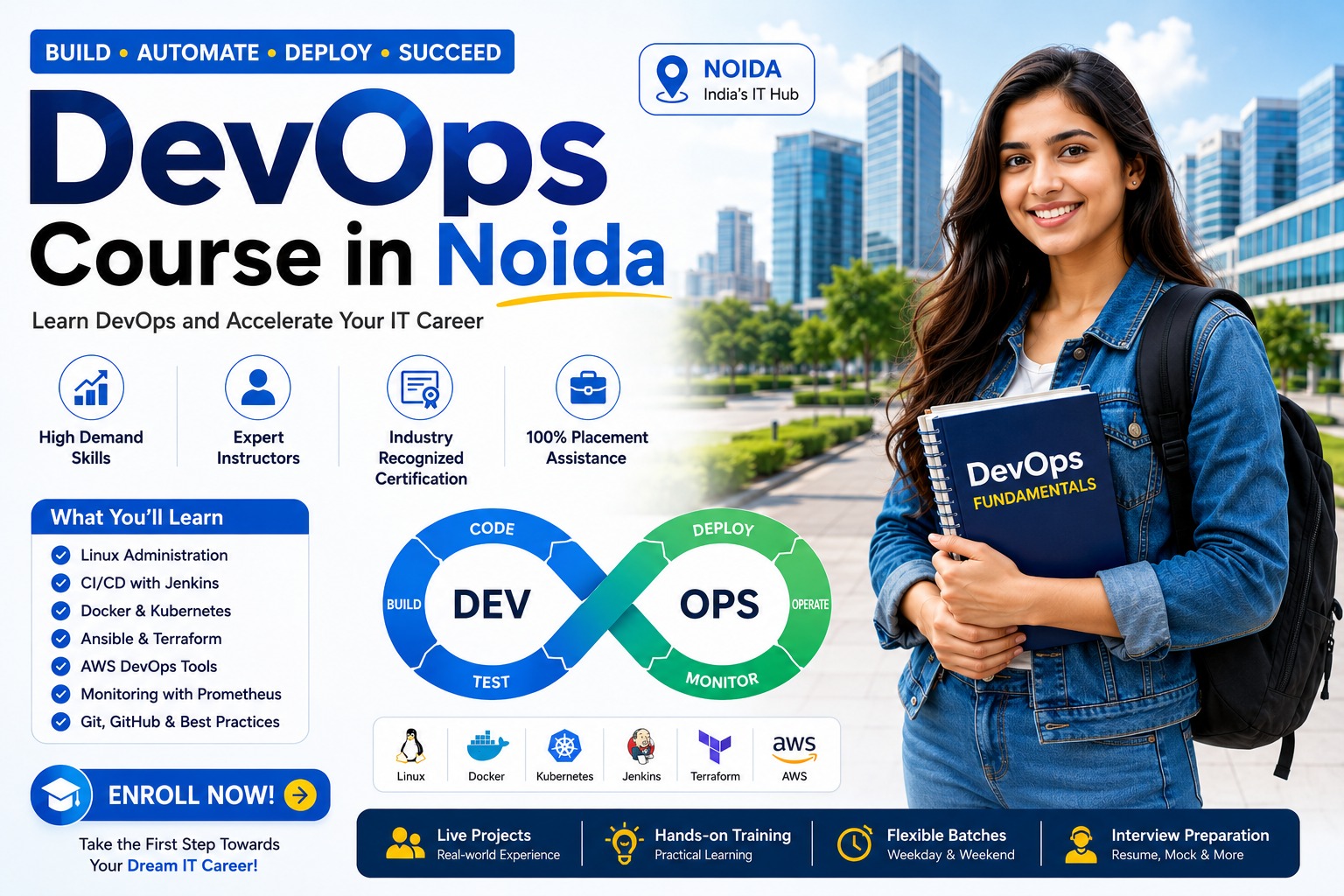
Noida hires differently from Delhi or Gurgaon. The jobs cluster in two corridors — the Sector 62/63 IT belt and the campuses along the Noida-Greater Noida Expressway — a mix of product engineering at Adobe and Samsung R&D, fintech scale at Paytm and Pine Labs, and large service floors at HCL, TCS and Coforge. This course is built around what those specific employers actually test for. Live online training, a separate GenAI module, and project work you can put a live URL on.
Why Noida is One of the NCR’s Strongest DevOps Markets
People underrate Noida because they lump it in with “Delhi NCR.” On the ground it has its own ecosystem, and it is a good one for DevOps. The density sits in two corridors, and unusually for the NCR, a real share of the hiring is product companies — not just services.

Sectors 62 & 63 — the core IT hub
- •Adobe development centre, IBM, and Samsung R&D (one of its largest outside South Korea)
- •Sector 62 floors of HCL, TCS, and Cognizant
- •Infrastructure-heavy environments — exactly where DevOps and cloud roles live
The Expressway corridor — product & scale
- •HCL has its biggest Noida campuses here, plus Sectors 125, 127, 132 and 135
- •Paytm — homegrown fintech running payments at national scale — is headquartered here
- •Companies running real traffic need real CI/CD, observability and Kubernetes, not theory
A genuine product-company city
- •Adobe, Oracle, Paytm, Pine Labs and Innovaccer all hire engineers in Noida
- •Product companies pay more and weight hands-on skill over certificates
- •A strong project portfolio moves the needle here more than a stack of badges
An honest read on the money
- •Software engineer salaries in Noida broadly span roughly 4-25 LPA by company and experience
- •For DevOps: entry around 5-9 LPA, mid-level commonly 10-20 LPA
- •Senior/SRE roles go higher at product companies — we will not quote a single fairy-tale average
DevOps Salary in Noida — A Realistic Range
| Experience | Realistic Range | Where These Roles Are |
|---|---|---|
| Entry (0-2 yrs) | 5-9 LPA | Service floors, GCCs, junior platform roles |
| Mid (3-5 yrs) | 10-20 LPA | HCL, Coforge, Adobe, Oracle, Paytm |
| Senior / SRE | 20 LPA+ | Product companies (Adobe, Paytm, Pine Labs) |
The honest range is what you should plan around. Your portfolio and interview performance move you within it more than any course badge does.
The Course in Brief
The syllabus is the same national programme taught in every batch: ten weeks of live sessions that run from Linux and Git through AWS, Docker, Kubernetes, CI/CD, Terraform, monitoring and DevSecOps, ending in a capstone, plus a separate ten-hour GenAI module with its own certificate. The week-by-week breakdown, the five projects and the GenAI labs are all on the course page, so this page sticks to what is specific to Noida.
What changes for Noida learners is the preparation around it: interview practice pitched at the two kinds of employer described above, Hindi explanations in doubt sessions when you ask for them, and weekend-only classes that leave the working week in the sectors untouched.
Full syllabus, projects and GenAI module ›From a Greater Noida College to Your First DevOps Role
A large share of the people who ask us about DevOps in Noida are final-year students or recent graduates from the colleges around Knowledge Park and the AKTU-affiliated campuses across the region. The honest picture first: very few companies hire a fresher straight into a DevOps title. Campus drives in this belt mostly bring service-company offers for developer, support or testing roles, and DevOps work comes after that.
That is less of a dead end than it sounds. Three routes work, and most people who make it use one of them:
- Take the service offer and move inward. Join the Sector 62 floor, and within the first year ask to be put on the team that owns build and release for your project. People who arrive already able to read a Jenkinsfile and fix a broken Docker build get that move far more often than people who wait to be trained.
- Go off-campus for a junior cloud or DevOps role. Product companies and smaller firms along the Expressway do hire juniors, but they hire on evidence. One application you deployed yourself, with a working pipeline and a live URL, carries further in those interviews than a list of certificates.
- Turn your final-year project into the evidence. If you are still in college, build the project as a deployed application on AWS with a pipeline behind it. You need a project anyway; this way it doubles as your portfolio.
Whichever route you take, the interview will start with Linux and a broken system. Freshers who can explain what they would check, and in what order, stand out immediately, because most candidates at this stage can only describe tools. The Linux for DevOps guide is a good place to start before the course does.
Sector 62 Service Floor or Expressway Product Team?
Noida puts both kinds of DevOps job within a few kilometres of each other, and they are different enough that it is worth choosing deliberately.
On a service floor you usually work on a client's infrastructure, inside the client's rules. Changes go through approval tickets and release windows, the tooling is whatever the client chose years ago (often Jenkins, often a mix of data-centre servers and cloud), and a lot of the work is keeping existing pipelines healthy. Interviews tend to test whether you know the standard tools and can follow a process without breaking anything.
On a product team the company owns the system end to end. You are closer to production, you carry an on-call rotation, and you are expected to improve the pipeline rather than just run it. Interviews go deeper: design a pipeline for this service, explain how you would roll back, tell us about something that broke. The pay is higher, and so is the bar.
Neither is the wrong choice. A common path in Noida is two or three years on a service floor, learning breadth across client environments, then a move to a product team once you have a real incident or migration to talk about. The DevOps career path guide covers when to make that move, and the salary guide covers what it tends to be worth.
Who Hires DevOps Engineers in Noida
We prepare you for the companies actually recruiting in and around Noida. These employers value demonstrable production skills over certificates alone — so the course is built to send you in with deployments to talk about.
Product & R&D
Pay more, weight hands-on skill
Service & Consulting
High-volume Sector 62/63 floors
Global Capability Centres
Large GCC engineering teams
Company names indicate the Noida hiring landscape our interview prep targets. They are not an endorsement or a guarantee of placement at any specific employer.
Available Across Noida, Greater Noida & Nearby
Training is 100% live online, so there is no commute through Sector 18 traffic or the expressway crawl. Both metro lines (Blue Line into Delhi, Aqua Line to Greater Noida) connect the city well, but for a skills course there is no reason to spend two hours a day commuting. Sessions are recorded, so a missed class is not a lost class.
Students join from across the region
Saturday & Sunday
3 hours per class, 6 hours a week
Live online, so the working week in Sector 62/63 stays untouched.
New Batch Every Sunday
Every session recorded
No long wait to start, and a missed class can be caught up from the recording.
Language note: Classes run in English for technical precision, with Hindi explanations available on request during doubt-clearing (हिंदी में समझाने के लिए बता सकते हैं) — useful for students from AKTU-affiliated colleges, Amity, JSS, and Hindi-medium engineering backgrounds across the region.
Book a Free DevOps Demo
The free demo is not a sales webinar — in about 45 minutes you build a small CI/CD pipeline yourself, so you can feel what the full course is like before paying anything. You also get an honest read on where you stand and a rough roadmap for your situation.
Who Teaches You
Pritam Phadtare
Lead DevOps Instructor · ex-DevOps Lead at Maxgen Technologies Pvt. Ltd · AWS Certified Solutions Architect
Pritam spent 8+ years in DevOps, most recently as a DevOps Lead at Maxgen Technologies Pvt. Ltd, where he sat on the hiring side of DevOps interviews. That is what he brings to teaching: he knows what a panel checks when a tester, a support engineer or someone from outside IT says they want to move into DevOps, and the course is built to close exactly those gaps.
He has taught every SwitchtoDevOps batch himself since 2021 — live, capped at 15 — and runs the GenAI-for-DevOps module personally.
What Our Students Say About This DevOps Course
Former students, in their own words
Book a Free DevOps Demo Session
In your free demo you will build a live CI/CD pipeline from scratch — not watch a slideshow. It takes 45 minutes and shows you exactly what the full course feels like.
- Free career counseling session
- Personalized learning roadmap
- Access to sample classes
- No payment required to start
Book your free demo
45 minutes, live with the instructor. No payment required.
We call you back within 24 hours. No spam.
Where our alumni have gone on to work
DevOps Course Fee, Duration and Batch Details
Transparent pricing with no hidden fees — pick the course that matches your goals
Professional DevOps Course
Course fee and payment options · 60 hours over 10 weeks · Weekend batches (Sat + Sun) · EMI available
DevOps Engineer roles (alumni report 8-16 LPA)
Expert DevOps Course
What is included in the course fee · 150 hours over 5 months · Full mentorship + placement
Senior DevOps/SRE roles (18-35 LPA market band)
Pay in easy installments
Full refund in the first week, if you have done under 20% of the course
Only 15 students per batch
2,000 off for both referrer & referee