DevOps Course in Gurgaon (Gurugram) for Cyber City Jobs
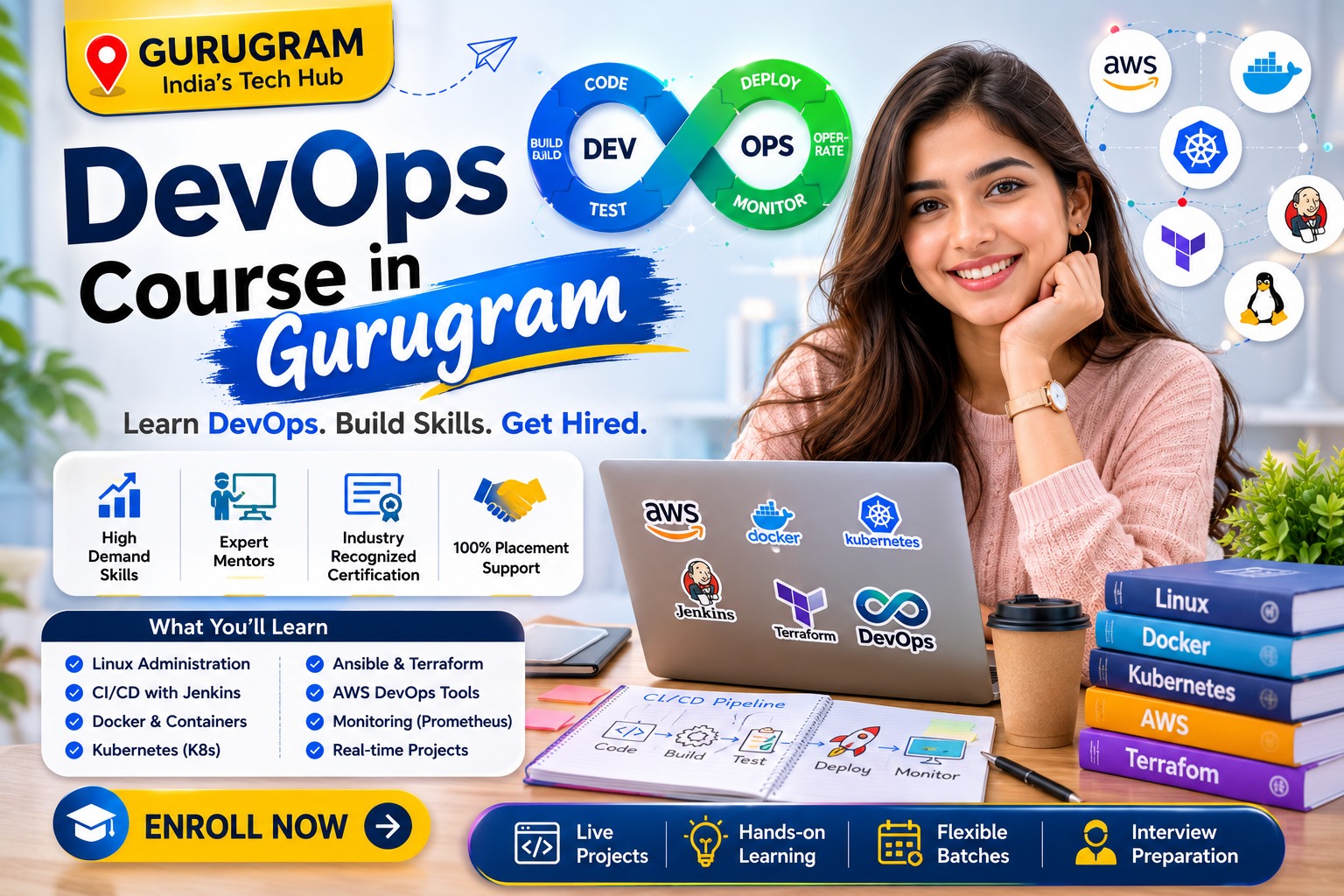
If you are aiming at Gurugram, you are aiming at the toughest and best-paid DevOps market in the country. This is Cyber City — Google, Microsoft, Amazon, Adobe and American Express on one side; Deloitte, EY, PwC and KPMG on the other; and a dense layer of product unicorns like Zomato, OYO, PolicyBazaar and Sprinklr that live and die by deployment speed. The bar here is genuinely higher — system design, SRE-style reliability questions and behavioural rounds, not just "list the Docker commands." This course is built backwards from those interviews.
Why Gurugram Pays the Most for DevOps in the NCR
Gurugram (officially Gurugram, still widely called Gurgaon) is not just another NCR satellite — it is where the money and the hardest tech problems concentrate. It also has the highest interview bar, so plan to earn it.

DLF Cyber City is the centre of gravity
- •Opened in 2003 off NH-48, packed with Fortune 500 offices
- •Google, Microsoft and Amazon run engineering here
- •Global capability centres scale infrastructure for parents abroad
The Big 4 hire DevOps at volume
- •Deloitte USI, EY GDS, PwC and KPMG run large cloud-transformation teams
- •They care about client-facing communication as much as raw skill
- •Our interview prep covers both the technical and behavioural sides
India's startup HQ city
- •Zomato, OYO, PolicyBazaar, Spinny, Urban Company, Sprinklr, Delhivery, Nagarro, MakeMyTrip
- •They need engineers who can own CI/CD, observability and on-call
- •They reward demonstrable skill over certificate counts
An honest read on the money
- •Be skeptical of tidy averages — Gurugram sits at the top of the NCR pay scale
- •Entry DevOps roughly 6-12 LPA; mid-level commonly 14-28 LPA
- •Senior/SRE roles at product companies and MNCs go higher still
DevOps Salary in Gurugram — A Realistic Range
| Experience | Realistic Range | Where These Roles Are |
|---|---|---|
| Entry (0-2 yrs) | 6-12 LPA | Service floors, GCCs, junior platform roles |
| Mid (3-5 yrs) | 14-28 LPA | Big 4, product startups, GCC engineering teams |
| Senior / SRE | 28 LPA+ | Google, Amazon, Adobe, top product companies |
Gurugram genuinely sits at the top end of the NCR pay scale — but it also has the highest bar. Your portfolio and interview performance decide where you land in that range.
What Makes This DevOps Course in Gurugram Different
Plenty of institutes list Gurgaon on their site. A few things we actually do:
Batches capped at 10
Not 30 or 50. In a Cyber City-grade interview the difference between an offer and a polite rejection is depth — and you do not build depth in a 40-person webinar.
Taught by a working DevOps engineer
Sessions are led by a practitioner with a TCS background and an AWS certification who has shipped production systems. You learn how things actually break and get fixed, not the textbook version.
MNC + product interview prep, not generic placement
Gurugram interviews lean on system design and SRE thinking. We run mock system-design rounds (CI/CD for many microservices, multi-region failover, cost control on large AWS bills) and behavioural mocks in the leadership-principle format the big players use.
A real GenAI module with its own certificate
Ten hours on the AI tooling working engineers now use daily — generating Terraform/Kubernetes manifests, AI-assisted debugging, an incident-summary bot. A real differentiator when an interviewer asks how you would use AI in your workflow.
DevOps Curriculum — 10 Weeks + GenAI Module
Core 10 weeks plus a separate 10-hour GenAI module — roughly 50+ hours live. Weekend and weekday-evening batches run live online.
Linux & Git Foundations
Topics: Command line, permissions, shell scripting, cron, Git workflows and branching
Lab: Environment setup and automation scripts
Cyber City interviews still start with solid Linux fundamentals
AWS Core Services
Topics: EC2, S3, IAM, VPC, RDS, CloudWatch
Lab: Deploy a 3-tier app with proper VPC and security groups
AWS appears in most Gurugram DevOps JDs
Docker & Containerization
Topics: Images, Dockerfiles, multi-stage builds, Compose, volumes
Lab: Containerize a microservices app
System-design rounds probe how deep your container knowledge goes
Kubernetes
Topics: Architecture, pods, deployments, services, ingress, autoscaling, Amazon EKS
Lab: Microservices on EKS with auto-scaling
The #1 technical requirement in Cyber City product JDs
CI/CD with Jenkins & GitHub Actions
Topics: Declarative pipelines, Jenkinsfile, GitHub Actions, blue-green and canary
Lab: Full pipeline from commit to EKS with automated tests
Product teams ask you to design a pipeline, not just define CI/CD
Terraform & Infrastructure as Code
Topics: HCL, AWS providers, state, modules
Lab: Provision your whole AWS stack with Terraform
"Write a Terraform module for EKS" is a common Gurugram interview task
Monitoring & Logging
Topics: CloudWatch, Prometheus, Grafana, ELK, SLIs/SLOs
Lab: Full monitoring stack with dashboards and alerts
Heavily tested in SRE rounds at Google-style interviews
DevSecOps & Capstone
Topics: Trivy, Checkov, Secrets Manager, Vault, SAST/DAST
Lab: Capstone tying Terraform + EKS + Jenkins + Prometheus + security scanning
Security is part of the JD at Big 4 and product companies
GenAI for DevOps (separate certificate)
Topics: AI for Terraform and Kubernetes YAML, Copilot for DevOps, AI-assisted incident response, basic LangChain workflows
Lab: A Slack bot that reads a failed deployment and posts a plain-English root cause
Answers the "how would you use AI in your workflow?" interview question
Certificate 1
DevOps Practitioner
10-week bootcamp completion with 5 live AWS projects
Certificate 2
GenAI DevOps Specialist
Separate certification for the 10-hour GenAI module
Five Live AWS Projects
Gurugram product companies and MNCs want proof. You will build and deploy work you can defend in a system-design round.
3-Tier E-Commerce App on AWS
Stack: React/Node, RDS, S3, load balancer
Deliverable: A public live URL that proves AWS fundamentals
Why it matters: The baseline Cyber City interviewers expect you to have built
Microservices Blog Platform
Stack: Docker Compose, service-to-service communication
Deliverable: A multi-service app you can walk through end to end
Why it matters: The exact architecture system-design rounds probe
Portfolio Site with CI/CD
Stack: S3, CloudFront, Route 53, GitHub Actions, SSL
Deliverable: Auto-deploys on every push, with a live URL
Why it matters: A live URL is instant credibility in an MNC interview
REST API with a Jenkins Pipeline
Stack: FastAPI/Express, Docker, Jenkins, Kubernetes
Deliverable: Full CI/CD from commit to Kubernetes
Why it matters: Mirrors how Gurugram product teams actually ship
Capstone: End-to-End DevOps Stack
Stack: Terraform + EKS + Jenkins + Prometheus/Grafana + ELK + security scanning
Deliverable: The full production system, infrastructure to monitoring to security
Why it matters: The piece most candidates cannot walk an interviewer through
Where Our Gurugram Students Get Hired
We prepare you for who is actually recruiting in and around Cyber City. These employers test for production-level skill and clear thinking under pressure — so the course is built to send you in with deployments to discuss and a system-design vocabulary.
Tech Giants / GCCs
System design + SRE rounds
Big 4 Consulting
Cloud transformation at volume
Product & Startups
Own CI/CD, observability, on-call
Service Companies
High-volume hiring floors
Company names indicate the Gurugram hiring landscape our interview prep targets. They are not an endorsement or a guarantee of placement at any specific employer.
A Real GenAI Module — The Way DevOps Engineers Actually Use AI
Ten hours on the AI tooling working engineers now use daily — not a buzzword overview. You leave with a second certificate: GenAI DevOps Specialist — a real differentiator when a Cyber City interviewer asks how you would use AI in your workflow.
AI for Infrastructure as Code
- •Generate Terraform configs and Kubernetes YAML from plain English
- •GitHub Copilot for Dockerfiles and manifests
- •Prompt patterns that actually work for DevOps tasks
AI-Assisted Debugging & Incident Response
- •Paste an error log, get root cause and a fix
- •Summarize a failed deployment into plain English
- •Basic LangChain workflows for DevOps automation
Capstone lab: a Slack bot that reads a failed deployment and posts a plain-English root cause — the kind of thing that makes a Gurugram interviewer lean in.
Available Across Gurugram & Nearby
Training is 100% live online — no crawling through the NH-48 / Cyber City bottleneck twice a day. Gurugram connectivity (Yellow Line to HUDA City Centre, Rapid Metro around Cyber City) is fine, but for a skills course an evening saved from traffic is an evening spent on labs. Sessions are recorded, so a missed class is not a lost one.
Students join from across the city
Weekday Evenings
Mon-Thu, 8:30-11:00 PM IST
Built for Cyber City professionals after office and traffic.
Weekends
Sat-Sun, 10:00 AM-1:00 PM IST
For students and anyone wanting weekdays clear.
Language note: Classes run in English for technical precision, with Hindi explanations on request during doubt-clearing (हिंदी में समझाने के लिए बता सकते हैं) — useful for students from Amity Gurugram, GD Goenka, Ansal, and Haryana engineering colleges (MDU Rohtak, DCRUST Murthal, NIT Kurukshetra) and Hindi-medium backgrounds.
Book a Free DevOps Demo
The demo is not a sales webinar — in about 45 minutes you build a small CI/CD pipeline yourself, so you know what the full course feels like before paying. You will also get an honest read on where you stand against the Gurugram interview bar.
Who Teaches You
Firoz Ahmed
Lead DevOps Instructor · AWS Certified Solutions Architect · 8+ years DevOps, ex-DevOps Lead at TCS
Every cohort is taught live by Firoz — not a rotating panel of junior trainers. He spent 8+ years as a DevOps and cloud engineer, including a DevOps Lead role at TCS, shipping production CI/CD, Kubernetes and Terraform infrastructure before moving into full-time teaching in 2021. Because batches are capped at 10, he knows where each student is stuck by the second week.
He keeps the curriculum current against what hiring managers actually ask in interviews, and runs the GenAI module himself rather than outsourcing it.
What Our Students Say About This DevOps Course
Real stories from real alumni — watch their journey
Book a Free DevOps Demo Session
In your free demo you will build a live CI/CD pipeline from scratch — not watch a slideshow. It takes 45 minutes and shows you exactly what the full course feels like.
- Free career counseling session
- Personalized learning roadmap
- Access to sample classes
- No payment required to start
Book your free demo
45 minutes, live with the instructor. No payment required.
We call you back within 24 hours. No spam.
Our students work at
DevOps Course Fee, Duration and Batch Details
Transparent pricing with no hidden fees — pick the course that matches your goals
Professional DevOps Course
Course fee and payment options · 50 hours · Weekend batches (Sat + Sun) · EMI available
DevOps Engineer (8-18 LPA)
Expert DevOps Course
What is included in the course fee · 150 hours · Full mentorship + placement
Senior DevOps/SRE Engineer (18-40+ LPA)
Pay in easy installments
100% refund within first week
Only 10 students per batch
2,000 off for both referrer & referee